
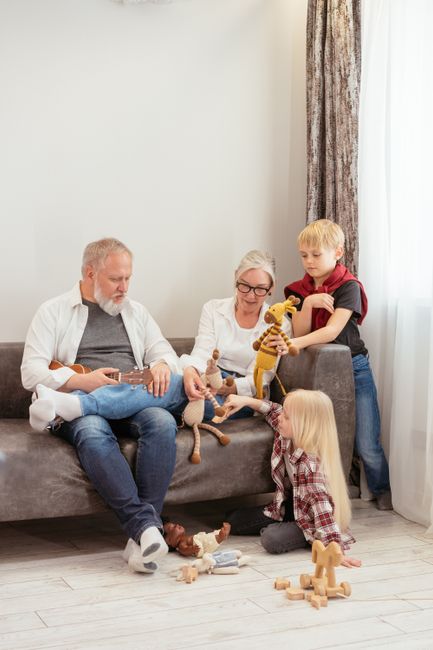
What are intergenerational activities in assisted living?
Intergenerational activities bring older adults and younger people together for shared conversation, learning, creativity, or play. In an assisted living setting, these activities may involve children, teenagers, college students, families, or other members of the community.
The purpose is not simply to keep residents busy. Well-planned interaction can support emotional health, cognitive engagement, physical activity, and a stronger sense of belonging. The most effective programs give everyone a meaningful role rather than treating older adults as passive observers or younger participants as visitors who need to be entertained.
Examples include:
- Reading together or sharing family stories
- Arts and crafts projects
- Gardening and seasonal planting
- Board games, puzzles, and simple group activities
- Music, singing, or instrument demonstrations
- Technology lessons led by younger participants
- Oral history or life-story projects
- Holiday, birthday, or seasonal gatherings
- Service projects that benefit the wider community
How can these activities benefit older adults?
Intergenerational activities can reduce loneliness, encourage conversation, and give residents regular opportunities to feel useful and connected. These benefits may be especially meaningful for people whose family members live far away or who have fewer chances to interact with children and young adults.
A resident may become more engaged when sharing a skill, explaining a tradition, or answering questions about earlier experiences. Someone who rarely joins large group programs may participate more readily in a small conversation with a child or teenager.
Possible benefits include:
- More frequent social interaction
- Improved mood and reduced feelings of isolation
- Opportunities to recall and share personal memories
- Practice with communication and decision-making
- Greater motivation to participate in daily routines
- A renewed sense of identity, purpose, or contribution
These activities should not be presented as a cure for depression, dementia, or other health conditions. They are one part of a supportive environment. A resident’s response may also vary depending on personality, health, hearing, vision, energy level, and past experiences.
Do intergenerational programs support memory and thinking?
They can provide useful mental stimulation, particularly when activities involve storytelling, problem-solving, music, or learning something new. Conversations with younger people may prompt residents to compare past and present experiences, remember family events, or explain how familiar objects and traditions have changed.
For residents living with memory loss, activities work best when they are simple, predictable, and focused on enjoyment rather than performance. A young visitor does not need to test a resident’s memory or correct every detail. Singing a familiar song, looking through picture books, sorting objects by color, or decorating cookies may be more comfortable than asking questions that feel like a quiz.
Helpful approaches include:
- Using clear, short instructions
- Allowing extra time for responses
- Avoiding pressure to remember names or dates
- Offering visual, musical, or hands-on choices
- Repeating familiar activities while adding small variations
- Focusing on the resident’s comfort and participation
The goal is connection, not perfect recall.
What do younger participants gain?
Younger people can develop patience, empathy, communication skills, and a more realistic understanding of aging. Regular contact may help reduce stereotypes that older adults are frail, disconnected from current life, or unable to learn.
Children may enjoy hearing stories about family traditions, work, school, transportation, music, or holidays from earlier decades. Teenagers and young adults may discover that residents have useful knowledge about writing, crafts, local history, careers, relationships, or overcoming difficult periods.
Intergenerational contact also gives younger participants practice in adapting their communication. They may learn to speak clearly, listen without interrupting, and notice when someone needs more time or assistance. These are valuable skills in families, schools, workplaces, and community life.
Why does this matter for families in Carlisle?
In Carlisle, seasonal weather can affect how often residents and families gather outdoors. Warm-weather programs may include raised-bed gardening, shaded walks, patio music, or outdoor art. During colder months, indoor activities such as baking, storytelling, card games, and craft projects can provide a dependable way to maintain social connection.
Households may also have varied schedules, transportation arrangements, and caregiving responsibilities. A structured visit can make family time easier because there is a shared activity to guide conversation. This may be particularly helpful for relatives who feel uncertain about what to do during a visit or who worry that conversation will become repetitive.
Local families do not need elaborate events to create useful connections. A grandchild reading aloud, a neighbor helping with a puzzle, or a teenager demonstrating how to use a tablet can become a meaningful exchange when the activity is paced appropriately.
How should activities be adapted for different abilities?
An activity should be flexible enough for residents with different mobility, hearing, vision, and cognitive needs. Participation may mean leading a discussion, choosing colors, listening to music, holding materials, offering encouragement, or simply being present.
For residents with limited mobility, supplies can be placed within comfortable reach and activities can be completed at a table. For people with hearing loss, smaller groups, reduced background noise, written instructions, and good lighting can make conversation easier. Residents with vision changes may benefit from large-print materials, textured objects, and verbal descriptions.
Staff and family members should also consider fatigue. A resident may enjoy an activity for fifteen minutes but need a quiet break afterward. Short sessions with an easy way to leave are often more successful than long events with pressure to stay.
What makes an intergenerational activity successful?
Successful programs are respectful, voluntary, and organized around mutual participation. The age difference should not be the entire focus. A shared interest—music, animals, cooking, crafts, stories, games, or nature—often creates a more natural connection.
Good planning includes:
- Matching the activity to participants’ abilities and attention spans
- Keeping groups small enough for conversation
- Preparing younger visitors for respectful interaction
- Explaining privacy and personal-boundary expectations
- Providing alternatives for residents who do not want to participate
- Avoiding loud, crowded, or rushed settings
- Checking whether the activity remains enjoyable over time
It is also helpful to avoid assumptions. Not every older adult enjoys children, crafts, singing, or group events. Some residents may prefer one-on-one conversation, while others may feel more comfortable watching before joining. Choice is part of dignity.
Are there common mistakes to avoid?
A frequent mistake is designing the activity mainly for younger visitors. If residents are expected only to watch a performance or receive a handmade gift, the exchange may feel one-sided. Activities are stronger when residents can teach, decide, create, ask questions, or contribute in a visible way.
Another concern is treating all older adults as though they have the same interests or abilities. Age alone does not determine personality, energy, culture, or comfort level. A resident who uses a wheelchair may still enjoy active decision-making, while a physically active resident may prefer a quiet conversation.
Photos and personal stories also require care. Permission should be obtained before taking or sharing photographs, and private information should not be discussed casually. Respectful boundaries protect both residents and younger participants.
How can families encourage meaningful connection?
Families can begin with simple, repeatable activities instead of waiting for a special event. Bringing a familiar recipe, looking through labeled photographs, listening to favorite songs, or working on a small puzzle can create a natural reason to talk.
Questions that invite stories are often more effective than questions with one correct answer:
- What was a favorite family tradition?
- What did people do for fun when you were young?
- How did you learn this skill?
- What advice would you give someone starting school or work?
- Which songs, foods, or holidays bring back good memories?
The best visits allow conversation to move at a comfortable pace. A resident does not have to perform, teach, or remember perfectly for the time together to be worthwhile.
